
Agricultural PTO Dynamometers
Article 1 of 3 – A Legacy in PTO Dynamometers
Allow me to introduce myself—I’m Aaron Warsaw, son of the late Arthur J. Warsaw, the visionary founder behind A&W Tractor Products and later AW Dynamometer. In 1957, my father designed, invented, and patented (U.S. Patent #3068689) the original friction Prony brake for use in agricultural PTO dynamometers—technology that formed the foundation of A&W’s product line. With over five decades of hands-on experience across a range of dynamometers, I offer this article as both a technical reflection and a personal account of the evolution of PTO testing.
So, how did PTO dynamometers come to be? The story traces back to around 1945, when Taylor Dynamometer Co. began manufacturing agricultural PTO dynamometers, utilizing a water (hydro-kinetic) brake as the load absorption mechanism. To their credit, Taylor’s solution was indeed a true dynamometer—it measured torque with reliable accuracy.
However, the design faced limitations. Water brakes require a gearbox to amplify brake speed for low-RPM, high-torque testing. They also depend heavily on stable water volume and pressure, which significantly restricts torque capacity at low operating speeds. This sensitivity meant even simple plumbing actions—like turning on a faucet—could cause the torque load to spike or drop unexpectedly.
Back then, 540 RPM served as both the manufacturer’s rated PTO speed and the industry standard for implements. By the mid-1960s, rising tractor horsepower drove that standard to 1000 RPM, a benchmark still in use today. Dual-shaft systems eventually emerged to accommodate both speeds. Taylor’s initial foray into the ag sector came through the Case PowrTest portable PTO dynamometer, built exclusively for J.I. Case.
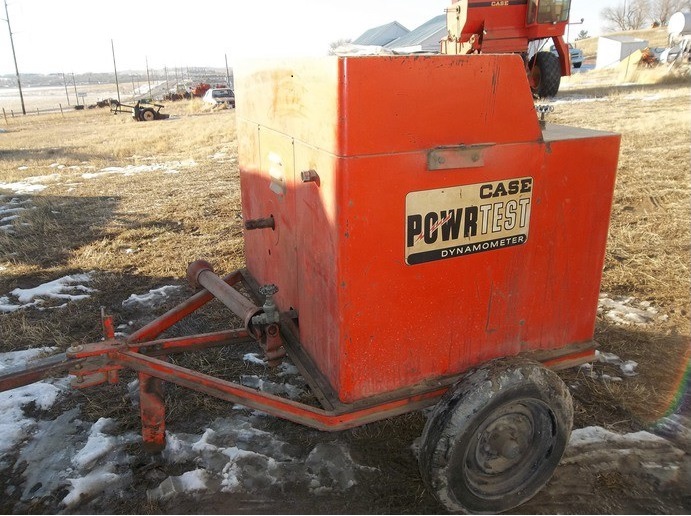 Taylor Dynamometer – Model Case Powrtest Dynamometer
Taylor later partnered with John Deere to produce the HI-EFF dynamometer.
However, John Deere quickly recognized the design’s critical flaw—its full dependence on water for torque loading. In an effort to improve performance and stability, Deere requested the addition of a dedicated water tank and pump to the unit. Taylor declined the request, effectively ending the collaboration and closing that chapter.
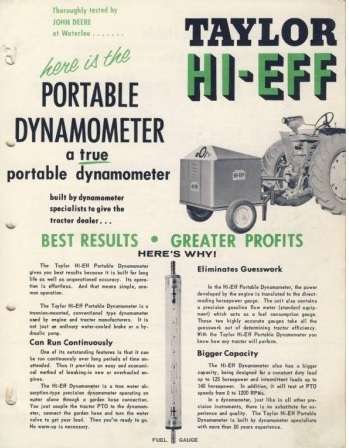
Taylor Dynamometer – HI-EFF tractor dynamometer
Even today, water cooling remains a persistent challenge.
Most U.S. tractor dealerships only have access to 6 to 10 gallons of water per minute for dynamometer cooling—barely sufficient for maintaining stable operating conditions under high torque loads.
M&W Gear Company started around 1946. The “W” in M&W was my father, as he was one of the founders. He was the creator and designer of a patented transmission gear package used to convert the Farmall M tractor’s standard 5-speed transmission to a 9-speed transmission. The Farmall M series tractor was the highest volume USA tractor ever built, with estimates of over 300,000 produced by the International Harvester Company.
After my dad started the M&W Gear Co. out of an old schoolhouse located in Anchor, IL, he left M&W in 1954. Let’s make one thing clear: During his tenure at M&W, he was not involved with the designing of the M&W agricultural pto dynamometer. Around the 1954-56 era, M&W began building a dynamometer, primarily to complement their new sleeve and piston business. Their dynamometer was used as a sales tool to display any increase in horsepower to customers using their products.
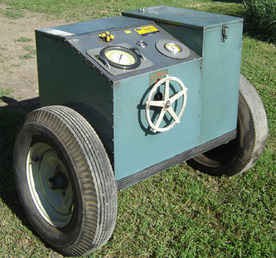 M&W Gear Co., Model P400
I’ll never forget a lesson my father taught me years ago.
He once pointed to page 715 of his 1936 Machinery’s Handbook, where the heading read simply: “Dynamometer.” Beneath it was a short but clear principle—torque is created by a lever, and in reverse, torque is measured by a lever. “That,” he told me, “is what defines a true dynamometer.” He emphasized that the M&W unit—while useful—was merely a loading device with a comparative readout, not a torque-measuring instrument.
Until 1958, M&W was the sole producer of agricultural PTO dynamometers. That changed when my father re-entered the field with his patented Prony brake design (U.S. Patent #3068689), specifically engineered to measure torque. His first major order came from International Harvester—600 model Sandbase dynamometers, each rated at 125 horsepower and sold for $600 apiece. Remarkably, these units were initially built in the garage behind our home in Colfax, Illinois. By 1962, production had grown enough to warrant a move to 131 East Main Street in Colfax, marking a new chapter in agricultural testing innovation.
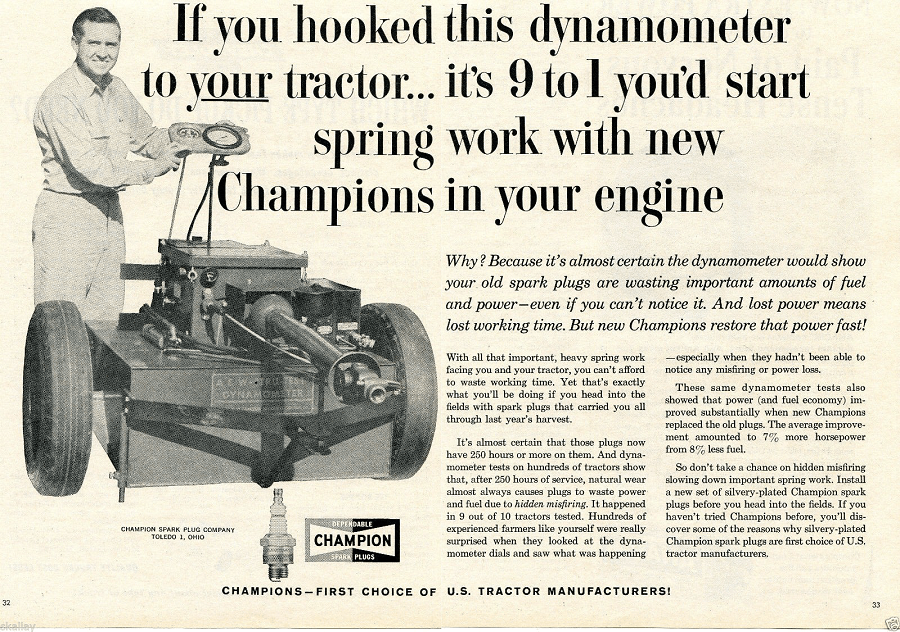 A&W Tractor Products, Model 1250